Power Trowel Manufacturer in India
Power Trowel Manufacturer in India
Concrete finishing is a critical stage in modern construction projects. Industrial floors, warehouses, parking areas, and infrastructure facilities require smooth, durable, and properly compacted concrete surfaces. Achieving this level of finishing requires specialized equipment designed to level and polish freshly poured concrete efficiently. One of the most widely used machines for this purpose is the power trowel.
Across India, large-scale construction activities in industrial zones, commercial buildings, logistics hubs, and infrastructure projects have increased the demand for advanced concrete finishing equipment. Builders and contractors rely on machines that improve surface quality, reduce manual labor, and deliver consistent results across large floor areas. A power trowel plays an important role in achieving these outcomes by ensuring a uniform and professional concrete surface finish.
Understanding Power Trowel Technology
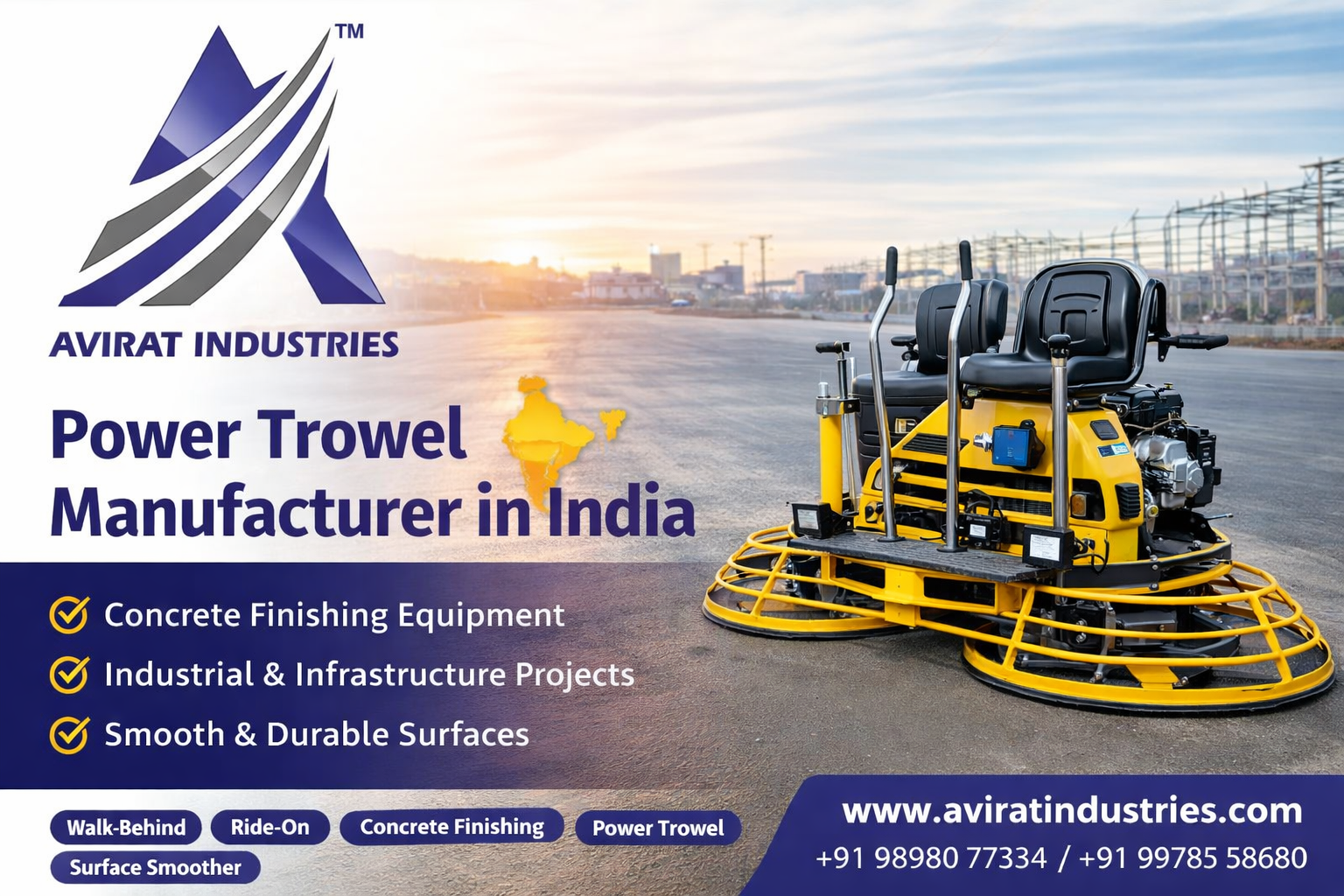
A power trowel is a mechanical construction machine designed to smooth and finish freshly poured concrete surfaces. The machine operates using rotating blades that move across the concrete slab to compress, level, and polish the surface. This process increases the density of the concrete while enhancing surface durability and appearance.
Compared to traditional manual finishing methods, power trowels provide faster and more consistent results. The rotating blades apply controlled pressure to the concrete surface, helping remove minor imperfections while producing a smooth and even finish. This significantly improves productivity on construction sites where large floor areas must be completed within limited time frames.
Modern power trowels are designed to allow operators to adjust blade angles, speed, and operational controls according to the stage of concrete curing. This flexibility enables contractors to achieve the required finishing quality without damaging the surface.
Role of Power Trowel Machines in Construction Projects
Concrete surfaces are widely used in industrial and commercial construction because of their strength and durability. However, achieving a smooth and properly finished concrete floor requires controlled finishing techniques. Power trowel machines are specifically designed to meet this requirement.
During the finishing stage, the machine moves across the slab surface and compresses the top layer of concrete. This process helps remove surface irregularities while improving the structural strength of the floor. A properly finished concrete surface also reduces dust formation and increases the lifespan of the slab.
In large construction projects such as warehouses, logistics facilities, parking structures, and factory floors, maintaining consistent surface quality across wide areas is essential. Power trowels help contractors achieve uniform finishing results efficiently and reliably.
Key Components of a Power Trowel Machine
A power trowel machine consists of several mechanical components that work together to produce smooth concrete surfaces. These components ensure stable operation, controlled finishing performance, and long-term durability.
Important components commonly found in power trowel machines include:
- Engine or motor that powers the machine
- Rotating blades that smooth and compact the concrete surface
- Adjustable blade pitch control for finishing precision
- Protective guard ring that improves safety during operation
- Handle or steering system that allows operator control
These components allow construction teams to operate the equipment effectively during different stages of the concrete finishing process.
Types of Power Trowel Machines Used in Construction
Construction projects vary in scale and surface requirements. As a result, different types of power trowel machines are used depending on the size of the slab and the project specifications.
Walk-behind power trowels are commonly used for small to medium construction sites. These machines are operated by an individual who guides the equipment across the concrete surface while walking behind it. They are suitable for residential floors, smaller industrial slabs, and commercial construction projects.
Ride-on power trowels are designed for large-scale concrete flooring operations. These machines allow the operator to sit on the equipment while controlling movement and blade operation. Ride-on trowels improve productivity in projects such as warehouses, airports, and large industrial plants where extensive floor areas require finishing.
Both types of machines play an essential role in modern construction by providing efficient finishing solutions for projects of different sizes.
Applications of Power Trowel Machines
Power trowel machines are widely used in various construction sectors where smooth and durable concrete surfaces are required.
Common applications include:
- Industrial warehouse flooring
- Commercial building floors
- Parking structures and basements
- Factory and manufacturing plant floors
- Logistics and distribution centers
- Infrastructure and large public construction projects
These machines help construction teams achieve consistent finishing results across large surfaces while improving overall efficiency.
Benefits of Using Power Trowel Machines
The use of power trowel machines in construction projects provides several operational advantages. Contractors depend on these machines to improve construction quality while reducing time and labor requirements.
Key benefits include:
- Improved surface smoothness and finishing quality
- Faster completion of concrete finishing work
- Reduced dependence on manual labor
- Consistent finishing across large floor areas
- Enhanced durability of concrete surfaces
- Better control during different stages of concrete curing
These advantages make power trowel machines an essential tool in modern construction practices.
Importance of Concrete Finishing in Industrial Construction
Industrial and commercial buildings often require durable flooring systems capable of handling heavy loads, machinery movement, and continuous operational activity. Proper finishing during the concrete curing process improves the overall strength and performance of these surfaces.
A well-finished concrete surface helps minimize cracks, improves resistance to abrasion, and reduces dust formation. These characteristics are particularly important in facilities such as manufacturing plants, logistics centers, and warehouses where flooring performance directly affects daily operations.
Power trowels support this finishing process by ensuring that the top surface layer of concrete is properly compacted and leveled.
Construction Equipment Demand in India
India's construction industry has experienced substantial growth due to infrastructure expansion, industrial development, and rapid urbanization. Large industrial parks, commercial complexes, and transportation infrastructure projects require modern construction equipment to maintain productivity and quality standards.
Concrete finishing machinery such as power trowels has become increasingly important in construction operations. Contractors are adopting mechanized solutions to improve efficiency and maintain consistent finishing quality across large-scale projects.
As construction technologies continue to advance, equipment that improves productivity and surface finishing quality remains essential for modern construction practices.
Factors to Consider When Selecting a Power Trowel
Construction professionals evaluate several factors when selecting a power trowel machine suitable for their project requirements. Equipment selection depends on project size, floor area, working environment, and finishing quality requirements.
Important considerations include machine size, engine capacity, blade diameter, operational control, and the durability of mechanical components. Contractors also assess maintenance requirements and the machine's compatibility with different construction site conditions.
Selecting the appropriate equipment ensures that finishing operations can be performed efficiently without compromising concrete surface quality.
Power Trowel Maintenance and Operational Safety
Regular maintenance and proper machine operation are essential for ensuring reliable performance of construction equipment. Power trowel machines require periodic inspection of mechanical components, blade condition, and engine performance to maintain operational efficiency.
Operators must also follow safety guidelines during machine operation. Proper handling procedures, protective equipment, and controlled machine movement help reduce the risk of accidents on construction sites.
Routine inspection and timely servicing contribute to long-term equipment performance while supporting safe construction operations.
Conclusion
Power trowel machines have become an essential part of modern construction operations where high-quality concrete finishing is required. These machines enable construction teams to achieve smooth, durable, and professionally finished concrete surfaces across industrial, commercial, and infrastructure projects.
With the continued growth of large-scale construction activities in India, the demand for reliable concrete finishing equipment is increasing. By improving surface quality, productivity, and operational efficiency, power trowel machines support the construction industry in delivering durable and long-lasting concrete structures.